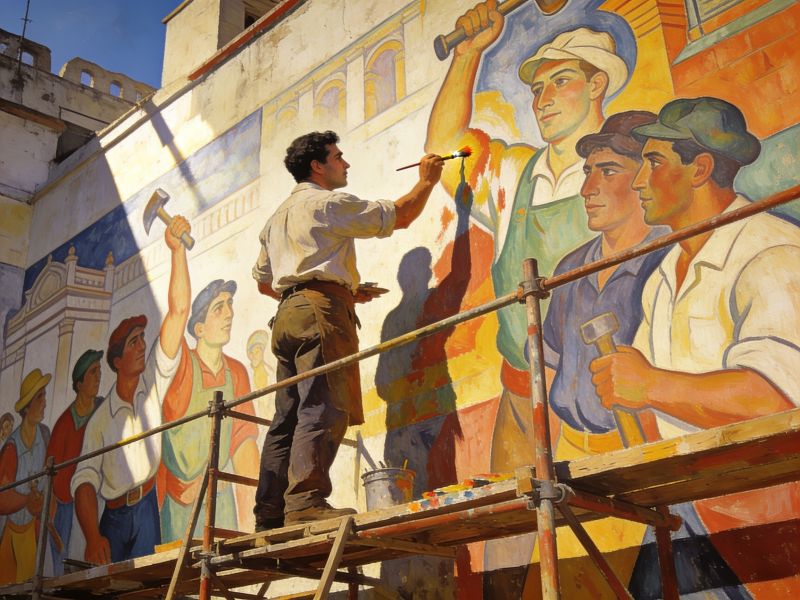
Diego Rivera didn't just paint walls—he turned them into public classrooms. In 1922, fresh from Europe and steeped in Cubism, Rivera returned to a Mexico still raw from revolution and began covering government buildings with scenes of indigenous farmers。factory workers, and revolutionary heroes. The sheer scale was audacious: at the Ministry of Public Education, he and a team of assistants filled 124 fresco panels across two courtyards over four years. Walking those corridors today, you feel the weight of a nation trying to define itself after decades of bloodshed. Rivera understood that art, to matter, had to be seen by everyone—not just collectors. That conviction made him a lightning rod, and it's why his name still sparks debate.His most famous commission, the Detroit Industry Murals at the Detroit Institute of Arts, reveals the tension in Rivera's work. In 1932, Edsel Ford invited him to depict the city's automotive heart. Rivera spent months inside Ford's River Rouge plant。sketching assembly lines and workers handling molten metal. The result: 27 fresco panels celebrating industrial labor—yet also hinting at its dehumanizing rhythm. Some critics called it communist propaganda;others saw a nuanced portrait of man and machine. Either way, the murals became a landmark. A personal observation: Rivera's genius lay in making ideological art feel human. The faces in those panels aren't abstract workers—they're specific people with calloused hands and tired eyes. That specificity is what separates propaganda from great art.
Rivera's relationship with the Rockefeller family is the stuff of legend. In 1933, Nelson Rockefeller commissioned him to paint a mural in New York's RCA Building. Rivera, true to form。included a portrait of Vladimir Lenin. Rockefeller demanded its removal;Rivera refused. The commission was cancelled, the mural destroyed. Rivera later recreated it in Mexico City's Palacio de Bellas Artes, calling it 'Man at the Crossroads.' The episode cemented his reputation as an artist who wouldn't compromise. Was it noble or stubborn?
Both, probably. But it also showed that Rivera treated muralism as a political act, not decoration. He once said, 'I paint what I see and feel, not what others want me to see.' That stubbornness cost him commissions but earned him a place in history.Beyond the politics, there's the craft. Rivera's fresco technique was masterful—applying pigment directly onto wet lime plaster, working fast and sure. He studied Renaissance masters in Italy, but his palette was distinctly Mexican: earthy reds, ochres, vivid blues. In 'The History of Mexico' at the National Palace, a sprawling epic spanning staircases and corridors, he compressed centuries into visual rhythm—Aztec markets, colonial abuses。revolutionary battles. The density is overwhelming. I stood before it once and felt dizzy, not from the size but from the sheer narrative load. Rivera packed more story into one wall than most filmmakers do in a trilogy. Yet he also had a tender side: his portraits of children and market scenes show a quiet warmth often lost in his political work.Rivera's legacy is complicated. He was a womanizer, a Stalinist, a man of contradictions. But he never wavered in his belief that art belongs to the public. His murals still provoke, still teach。still challenge. In a world where art often sits behind velvet ropes, Rivera's work reminds us that walls can speak. Walk into any building he touched—the Ministry of Education, the Bellas Artes, the Detroit Institute—and you'll see his voice loud and clear. That voice isn't always comfortable, but it's never dull. And that's why Rivera matters: he made art impossible to ignore.